In 2009, Fruit of the Loom signed a landmark agreement with the Central General de Trabajadores (CGT), a major Honduran labor union. This agreement was reached after a year of campaigning by workers and students against the company’s blatant union-busting, including the closure of a factory where workers had unionized. The agreement committed Fruit of the Loom to respect workers’ rights to organize across its Honduran garment factories. The reopening of the closed factory created what researchers call a “snowball effect”, with unions forming at many of Fruit’s own factories, and then across the country. By the end of 2021, 22 collective bargaining agreements covered 46,000 garment workers – roughly 44 percent of the 105,000 people making clothing in Honduras.
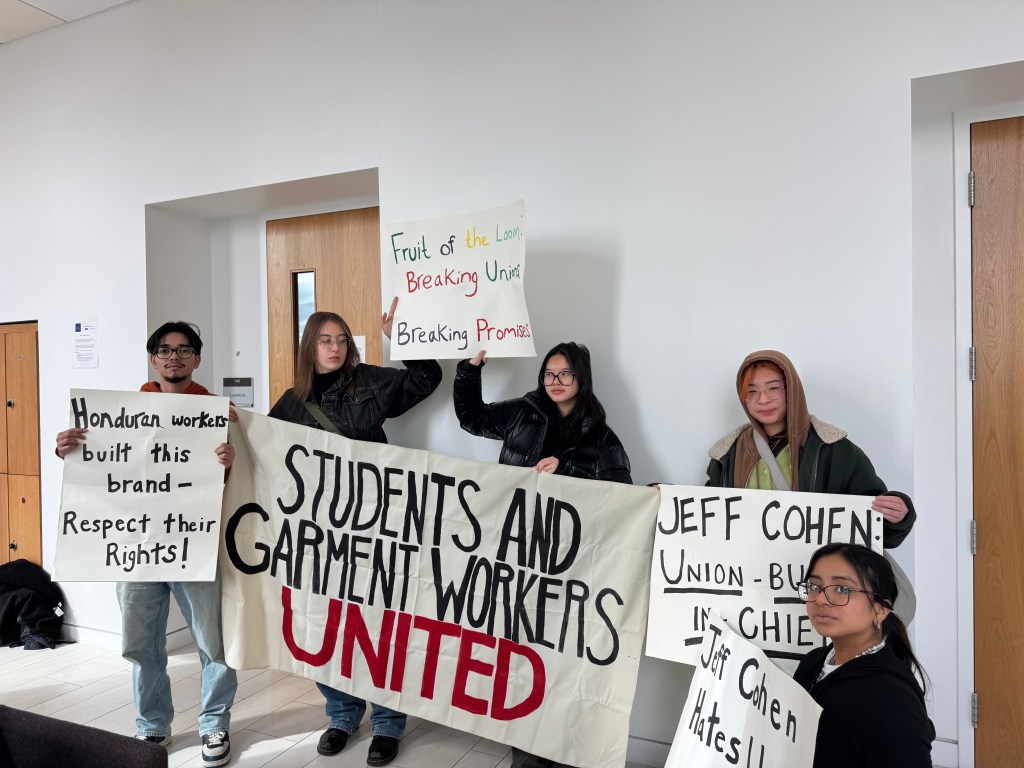
But now, Fruit of the Loom is reversing all that progress by closing their last two unionized garment factories: Jerzees Nuevo Día and Confecciones Dos Caminos. These closures will devastate over 3,000 workers and their families, when they close in May 2025. Significant layoffs at both facilities are already under way.

The closure of Jerzees Nuevo Dia is union-busting”
SITRAJERZESND – CGT Honduras

SITRAJERZESND – CGT Honduras
“For non-union workers to see that the two factories that do have a union have been shutdown is only going to make workers more fearful of organizing”
– Evangelina Argueta, Central General de Trabajadores
Fruit of the Loom tried union-busting before: Students, labor activists, and workers successfully forced them to reopen their unionized factory
In one of the most significant victories in the history of the anti-sweatshop movement, workers, students, and labor activists came together to accomplish what Fruit of the Loom didn’t think was possible: they forced the global apparel giant to reopen a factory it tried to shutdown after workers unionized.
When Russell Athletics, owned by Fruit of the Loom, closed its unionized factory in Honduras in early 2009, firing 1,200 workers in retaliation for organizing, they thought they could get away with it. They realized they were wrong, when student anti-sweatshop activists, in coordination with unionized Honduran garment workers, executed a relentless international campaign that spanned more than a year. Students campaigned on their campuses which resulted in over 100 campuses cutting their contracts with Russell Athletic. Off-campus, they picketed outside the N.B.A. Finals in Orlando, protesting the league’s contract with Russell. They took the fight to major retailers by handing out flyers at stores, such as Sport Authority. Students, workers, and labor activists made sure Fruit of the Loom had nowhere to hide.
“[Jerzees Nuevo Dia] was the doorway through which workers all across Honduras walked to substantially transform the industry…Honduras is the only country in the industry globally where the majority of workers are protected by genuine collective bargaining agreements. That all arises from that breakthrough.”
– Scott Nova, Worker Rights Consortium
 Rotten Fruit of the Loom